The platform
Two things listening. Neither of them deciding.
RepleteCare runs two systems through a consultation. An ambient scribe that hears the visit in the language it happens in and writes the note. And a clinical harness sitting on top of it, tracking whether the consultation has covered what it should. Both propose. You dispose.
The ambient scribe
Ten Indian languages, English, and the switching between them.
A scribe that only works in English is a scribe that doesn't work in most of India. Ours is built on a large multilingual speech model, fine-tuned on Indian clinical speech — the accents, the drug names, the shorthand a specialist actually uses — so the note comes out right without anyone speaking unnaturally for the software's benefit.
It handles the thing that breaks most transcription in an Indian OPD: code-switching. You ask in English, the patient answers in Marathi, you clarify in Hindi. The scribe follows the switch mid-sentence and keeps one coherent clinical note underneath it.
- हिन्दी Hindi
- বাংলা Bengali
- తెలుగు Telugu
- मराठी Marathi
- தமிழ் Tamil
- اردو Urdu
- ગુજરાતી Gujarati
- ಕನ್ನಡ Kannada
- മലയാളം Malayalam
- ਪੰਜਾਬੀ Punjabi
- English
Written for the chart, not a transcript
You get a structured clinical note — history, examination, assessment, plan — not a wall of dialogue you'd have to rewrite anyway.
The patient reads their own language
Prescriptions, care instructions and reminders go out in the patient's language — which is often not the one the note was written in.
Consent-first, and visible
Ambient capture runs with consent, and the interface always shows when it is listening. Never a hidden microphone.
The clinical harness
A second pair of ears on every consultation.
The scribe captures what was said. The harness watches what wasn't.
It listens alongside the scribe with a model of what a thorough consultation for this presentation involves, and quietly surfaces the gap — a question not yet asked, a red flag not yet excluded, a piece of history that would change the plan. It appears in a side panel while you consult, so you can close the gap in the room rather than discover it a week later.
What hasn’t been asked
It tracks the history a thorough workup for this presentation would cover, and surfaces what hasn’t come up — the red-flag question, the medication history, the family history that changes the differential.
What’s worth ruling out
When the picture forming in the note is consistent with something that shouldn’t be missed, it says so — with the guideline or chart entry that prompted it, so you can judge the reasoning rather than trust it.
What’s already covered
Anything you’ve addressed drops off the list as you address it. The panel shrinks through the consultation instead of nagging, so it ends quiet rather than loud.
Where its authority ends. The harness raises questions and considerations. It does not diagnose, it does not rank a differential as a conclusion, and it never writes to the chart on its own. Every prompt is something you ask, dismiss, or ignore — and the whole harness can be switched off for a patient or for your entire practice, with the rest of the platform unaffected.
Documentation
Documentation that doesn’t cost you the patient.
The whole consultation lives on one screen instead of scattered across tabs and modals — history, examination, diagnosis and plan, all in one place.
The note drafts itself section by section as you talk, for you to accept or edit. Normal findings fill themselves in from your own examination habits; only the abnormal needs typing. A fully documented new consultation in under five minutes, a follow-up in under three.
It’s the difference between software that demands attention and software that gets out of the way.
Governed AI
The AI proposes. The doctor disposes.
Everything either system suggests — a drafted note section, a flagged interaction, a harness prompt — traces back to something in the chart or a cited clinical source. If it can’t point to where it got something, it doesn’t show it.
Tap any suggestion, see its source
A specific chart entry or a cited guideline — never a source-less assertion.
Nothing auto-commits. Ever.
You accept, edit or ignore each one, and that decision is logged and attributable.
Turn either one off
Scribe, harness, or both — per patient or practice-wide. The EMR works the same without them.
The full governance story — data residency, audit trails and our clinical-safety review process — is on the Security & Compliance page.
Between visits
It follows the patient home.
Most EMRs stop working the moment the consultation ends. This one doesn’t: after a visit, an automated — but doctor-governed, script-approved — loop checks in on medication adherence, chases down the lab report that hasn’t come back, reads reports the moment they’re uploaded and flags anything urgent, and books the follow-up automatically. All of it over WhatsApp, because that’s where Indian patients actually are.
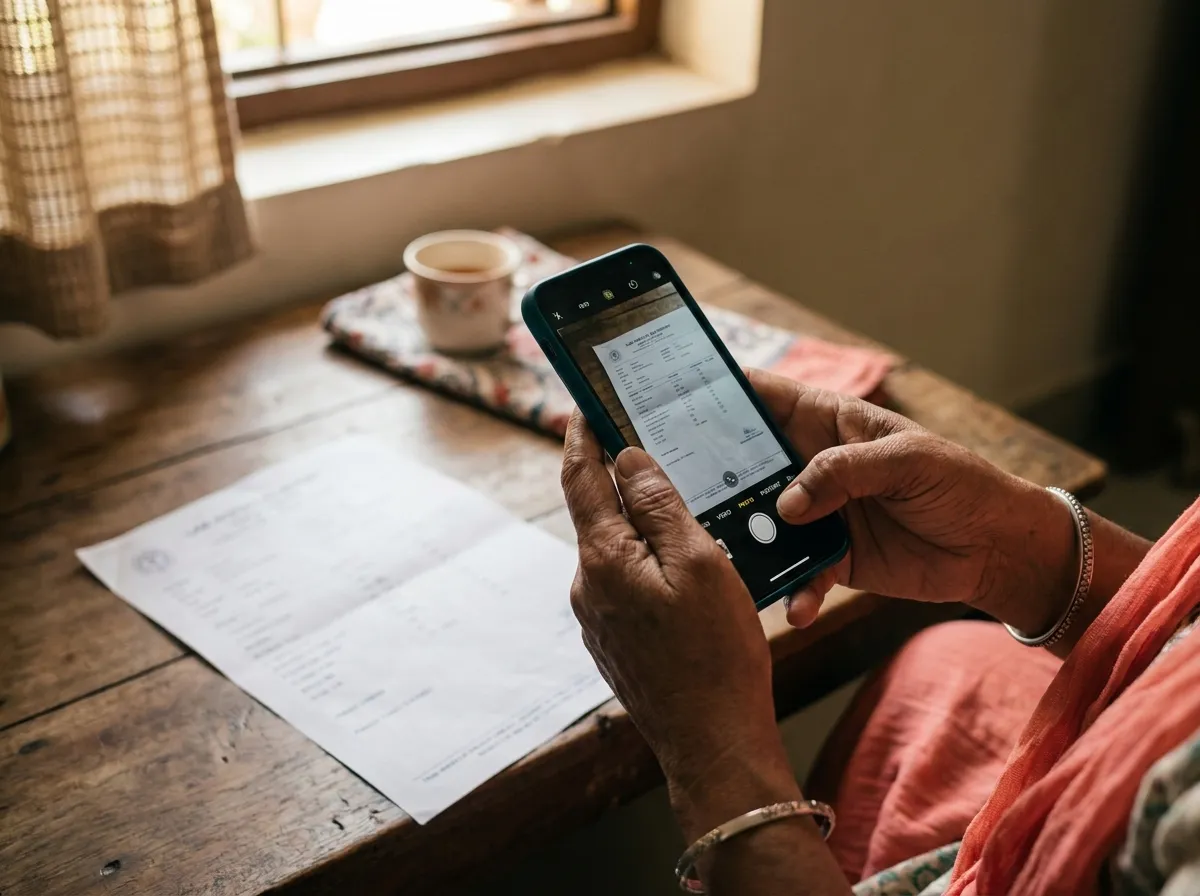
A gentle nudge
A WhatsApp check-in on medication adherence, or a reminder that a test is due.
A firmer one
If the lab report still hasn’t come back, the follow-up gets more persistent — automatically.
A human takes over
Still nothing? A task lands with your clinic staff to make an actual phone call — the chasing a solo practice rarely has spare hands for.
And it knows its limits: if a patient asks an actual clinical question, it goes straight to your worklist rather than answering on its own. The automation handles the logistics of follow-through; you still own every clinical call.
Engineering reality
Built for Indian clinics, not adapted for them.
- Offline through patchy connectivity and power cuts — a note started before the power goes out doesn’t disappear; everything syncs when you’re back online.
- ABDM/ABHA-native — India’s digital health rails are built into the foundation, not added for a compliance checkbox.
- Handles 60–100 patients a day — the workflows are designed around real OPD volume, which is exactly why the under-5-minute constraint exists.
- Language the way it’s actually spoken — ten Indian languages plus English, mid-sentence switching included, and patient-facing material in the patient’s own language.
The operating model
Specialty depth isn’t a launch feature. It’s the whole model.
Every specialty RepleteCare builds gets the same treatment — proven in neurology first, then carried into each new specialty. This is the argument for why “multi-specialty” doesn’t have to mean “shallow.”
Validated clinical scales
The severity and outcome scales your specialty actually runs on, built into the exam itself — not bolted on as separate forms.
Disease-specific registries
Structured registries for the conditions that define long-term care in your specialty, not free-text buried in old notes.
Protocol-driven follow-up
Follow-up intervals that match how each condition is actually managed, scheduled and chased automatically.
A harness that knows the specialty
What counts as a complete consultation differs by specialty. The harness is built against each one’s real workup, not a generic checklist.
See it against your own OPD day.
Request early access and tell us your specialty and the languages your clinic runs in — we’ll show you what a complete consultation looks like in under five minutes.
No subscription fee for the core platform. No credit card. No hardware to buy.